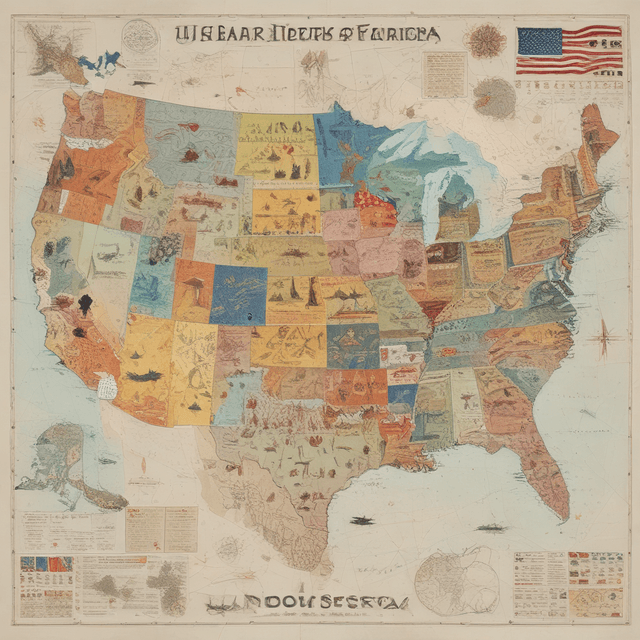
| Key changes | Shifting borders and alliances • Increased autonomy and diversity • Occasional wars between states |
| Former entity | |
| Current states | New England Confederation • Appalachian Federation • Great Lakes Alliance • Texas Republic • California Pact • Rocky Mountain Dominion • Pacific Northwest Collective |
| Current system | Decentralized, with states operating largely independently |
| Emergence from |
The landmass that was once known as the United States of America is now divided into a patchwork of independent nation-states, each with its own distinct political, economic, and cultural character. This system of multiple sovereign states emerged gradually over the centuries following the collapse of the original American union.
The major states that exist in this timeline include:
The New England states were the first to break away from British rule and establish themselves as an independent confederation in the late 18th century. They have maintained a generally liberal, democratic political tradition and a diversified economy centered on manufacturing, technology, and maritime trade.
This region was the heartland of the original American rebellion, but the states here took different paths after independence. New Rotterdam (formerly New York City) became the capital of an independent Dutch-speaking nation, while the other Mid-Atlantic states developed as more diverse, mercantile republics.
The Chesapeake states coalesced into a semi-federal union after a series of conflicts with New England and the Mid-Atlantic powers. They are known for their agrarian economies, aristocratic political structures, and distinct regional culture.
Carved out of the western territories, these young states have been defined by westward expansion, resource extraction, and frequent conflicts with Native American nations. Their political systems range from populist democracies to authoritarian militias.
Encompassing the former Louisiana Purchase and other lands west of the Mississippi River, this diverse region has seen power struggles between different factions - from Spanish and French colonial empires to independent Native American kingdoms and Anglo-American settler states.
The western frontiers were the last to be colonized and the site of many conflicts, both between colonial powers and with indigenous peoples. In the modern era, the Far Western states have developed their own dynamic economies and cultures, from the cattle ranches of Texas to the tech hubs of California.
This patchwork of nation-states has arisen from the ashes of the former United States, with shifting alliances, rivalries, and periodic outbreaks of conflict between them. The lack of a unifying federal government has allowed for greater diversity but also instability, as the states jockey for regional hegemony and global influence. The future of this fragmented landscape remains uncertain.
